From targeting to exfiltration: stop cyberattacks with the Cyber Kill Chain and Olfeo
It is no longer a secret that cyberattacks are increasing in both frequency and sophistication, forcing companies to develop more robust and innovative IT defense strategies. In response to this growing threat, the Cyber Kill Chain is one of the leading concepts for better understanding, modeling, anticipating, and countering cyberattacks. In this article, we will explore this essential concept in greater depth and examine how Olfeo, through its Secure Service Edge (SSE) offering, can play a central and decisive role in protecting modern information systems.
Understanding the Cyber Kill Chain
The Cyber Kill Chain is a conceptual model developed by Lockheed Martin, designed to illustrate the various stages of a cyberattack's life cycle, from the initial reconnaissance phase to the final exfiltration of data.
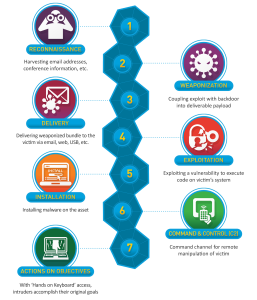
This model is broken down into seven critical phases:
1. Recognition
This initial phase is essential for the attacker, who uses social engineering, network scanning, and open source intelligence (OSINT) techniques. Tools such as Shodan, Nmap, and Maltego can be used to discover IP addresses, open ports, exposed services, and software versions. CISOs should be aware that publicly available information about employees, infrastructure, or partners can be exploited to prepare tailored attacks. As such, information shared on social media is particularly monitored by attackers to build more accurate, realistic, and contextual phishing emails.
2. Armament
In this phase, the attacker designs specific payloads tailored to the identified target. This includes customized malware that evades traditional defenses such as antivirus or EDR, using techniques such as encryption, polymorphism, or fileless malware. Tools such as Metasploit or Cobalt Strike can be used for this customization. CISOs must ensure that their teams have security solutions capable of analyzing abnormal behavior rather than relying solely on signatures.
3. Delivery
The delivery phase sees the attacker using mechanisms such as spear phishing, software or network equipment exploits, or compromising software supply chains to introduce malware into the target environment. Weak usernames and passwords or authentication systems that do not use MFA can also be compromised and used to deliver the payload.
The use of encrypted channels makes detection more difficult. CISOs must implement advanced email security solutions and ensure that all applications and systems are regularly patched and updated.
4. Operation
Once delivered, the attack vector attempts to exploit one or more vulnerabilities to execute its code. This could include exploiting zero-day vulnerabilities or known but unpatched vulnerabilities. Techniques such as buffer overflow exploitation, SQL injection, or exploitation of weaknesses in network protocols may be employed. CISOs must ensure that patch management is rigorous and that sandboxing mechanisms are in place to limit the impact of such exploits.
5. Installation
Installing a backdoor or rootkit allows the attacker to maintain stealthy and persistent access. Tools such as Cobalt Strike or Empire are often used to establish these footholds. The use of persistence techniques such as modifying operating system registry keys or adding scheduled tasks ensures that access persists even after a reboot. CISOs must ensure continuous monitoring of systems to detect such unauthorized changes.
6. Command and control (C2 servers)
The attacker sets up a communication channel between the compromised system and their command-and-control infrastructure, often using encrypted protocols to hide C2 traffic within legitimate network traffic. DNS tunneling, HTTP/HTTPS, and botnets are typically used. The use of detection techniques based on abnormal behavior and network flow analysis is essential for CISOs to detect these hidden communications.
7. Actions on objectives
Finally, the attacker achieves their ultimate goals, whether it be data exfiltration, file encryption for ransom demands, or sabotage of key operations. Advanced exfiltration techniques, such as steganography or segmented and encrypted data transfer, may be used. CISOs must ensure that DLP (Data Loss Prevention) and EDR (Endpoint Detection and Response) solutions are in place to monitor, alert, and potentially block these malicious actions.
In short, each stage of the attack cycle requires specific, proactive security measures to anticipate and mitigate threats, with synergy between prevention, detection, and incident response technologies.
The Cyber Kill Chain compared to the Mitre Att&ck framework
The Cyber Kill Chain and MITRE ATT&CK are two strategic frameworks in cybersecurity, but the Cyber Kill Chain stands out for its linear approach and unique advantages. This clear structure facilitates a comprehensive understanding of attacks, even for less specialized teams. One of the main advantages of the Cyber Kill Chain is that it allows you to visualize defense opportunities at each stage, providing a systematic framework for detecting and interrupting threats before they reach their final objective. It is particularly effective for identifying weaknesses in the attack lifecycle and optimizing defensive strategies. Unlike MITRE ATT&CK, which focuses more on the specific tactics and techniques used by attackers after the initial intrusion, the Cyber Kill Chain offers a macro and strategic perspective, helping to anticipate the future stages of a malicious campaign. It is also more accessible to organizations in the early stages of cybersecurity maturity, providing them with a clear basis for structuring their defensive approach. In short, the Cyber Kill Chain excels as a tool for strategic analysis and attack prevention while enabling simplified communication between security teams and decision-makers.
How Olfeo Can Help at Every Stage of the Cyber Kill Chain
Olfeo, with its Secure Service Edge (SSE) offering, provides a range of innovative solutions designed to intervene effectively at every stage of the Cyber Kill Chain. This intervention aims to prevent, detect, and respond to cyber threats with increased efficiency.
Recognition
Right from the reconnaissance phase, Olfeo helps minimize risks by providing sophisticated monitoring tools that detect risky or abnormal activities associated with information gathering by attackers. For example, employee traffic to risky sites or unauthorized SaaS applications—thanks to Shadow IT detection—can alert administrators to risky practices.
Delivery and Operation
During the delivery and operation phases, Olfeo's web filtering plays a decisive role. By strictly controlling access to malicious websites and blocking suspicious downloads, Olfeo significantly reduces the risk of infection via common vectors such as phishing or infected files. Similarly, flow antivirus software and HTTPS traffic analysis help identify potential malware deliveries.
Command and Control (C2)
During the command and control phase, Olfeo works to prevent communications between the compromised system and the attacker's infrastructure. Thanks to rigorous security policies and effective network traffic filtering, Olfeo is able to interrupt and block C2 communication attempts, thereby reducing the attacker's ability to manipulate the infected system.
Actions on objectives
Finally, Olfeo plays a vital role in protecting sensitive data and preventing malicious actions targeting the ultimate objectives of the attack. Olfeo's security solutions incorporate advanced data loss prevention (DLP) tools, including detection of massive data exfiltration, which minimizes potential damage in the event of a compromise.
Conclusion
The Cyber Kill Chain provides an invaluable analytical framework for understanding and countering the sophisticated cyberattacks that threaten modern organizations. Building on its ESS offering, Olfeo is proving to be an indispensable tool for companies seeking to strengthen their security posture at every stage of this model. By combining proactive detection, rigorous web filtering, and robust security policies, Olfeo enables companies to guard against ever-evolving threats and protect their most valuable assets in today's digital landscape. With its ability to adapt and customize its solutions to specific customer needs, Olfeo has positioned itself as a key leader in the field of cybersecurity.